Driving Growth Through PDP Optimization
Increasing product page engagement and reducing decision friction on Dell.com
Role
Product Designer
Timeline
4 months
Team
Cross-functional team
Experiment Details
A/B Test, 100+ users
Driving Growth Through PDP Optimization
Increasing product page engagement and reducing decision friction
Role
Product Designer
Timeline
4 months
Team
Cross-functional team
Experiment Details
A/B Test, 100+ users

Original PDP layout with dense technical specs and unclear information hierarchy, contributing to decision friction and dissatisfaction rates.
Problems at a glance
📈 High Bounce Rate
Customers drop early
👎 High DSAT
Customer Dissatisfaction High
🤷♀️ Specs Unclear
20% DSAT related to content misunderstanding
🛒 Low Conversion
High visits, low CVR
💸 Revenue Impact
Quarterly financing loss
Project Overview
Dell.com Product Detail Pages attracted high traffic but failed to convert consistently. High bounce rates, elevated DSAT, and content-related confusion (20% of negative feedback) indicated significant decision friction. Users reached PDPs with intent but lacked the clarity needed to confidently purchase, resulting in low conversion rates and measurable quarterly revenue loss.
Original PDP layout with dense technical specs and unclear information hierarchy, contributing to decision friction and dissatisfaction rates.
Problems at a glance
📈 High Bounce Rate
Customers drop early
👎 High DSAT
Customer Dissatisfaction High
🤷♀️ Specs Unclear
20% DSAT related to content misunderstanding
🛒 Low Conversion
High visits, low CVR
💸 Revenue Impact
Quarterly financing loss
Project Overview
Product Detail Pages attracted high traffic but failed to convert consistently. High bounce rates, elevated DSAT, and content-related confusion (20% of negative feedback) indicated significant decision friction. Users reached PDPs with intent but lacked the clarity needed to confidently purchase, resulting in low conversion rates and measurable quarterly revenue loss.
Original PDP layout with dense technical specs and unclear information hierarchy, contributing to decision friction and dissatisfaction rates.
Problems at a glance
📈 High Bounce Rate
Customers drop early
👎 High DSAT
Customer Dissatisfaction High
🤷♀️ Specs Unclear
20% DSAT related to content misunderstanding
🛒 Low Conversion
High visits, low CVR
💸 Revenue Impact
Quarterly financing loss
Where users got stuck
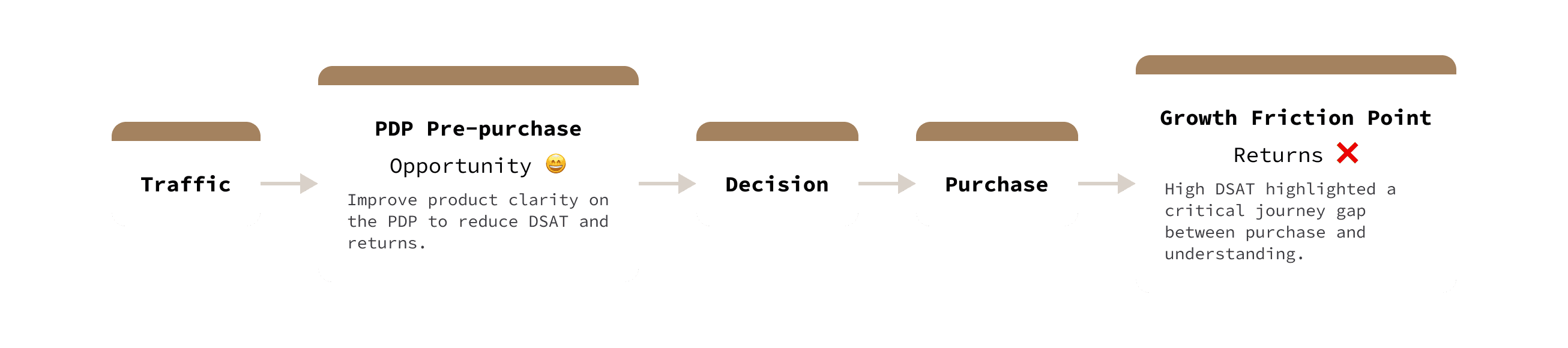
High-intent users reached PDPs but lacked the clarity needed to confidently purchase, resulting in drop-offs, low conversion, high dissatisfaction rates and revenue impact.
Evidence & Benchmarks
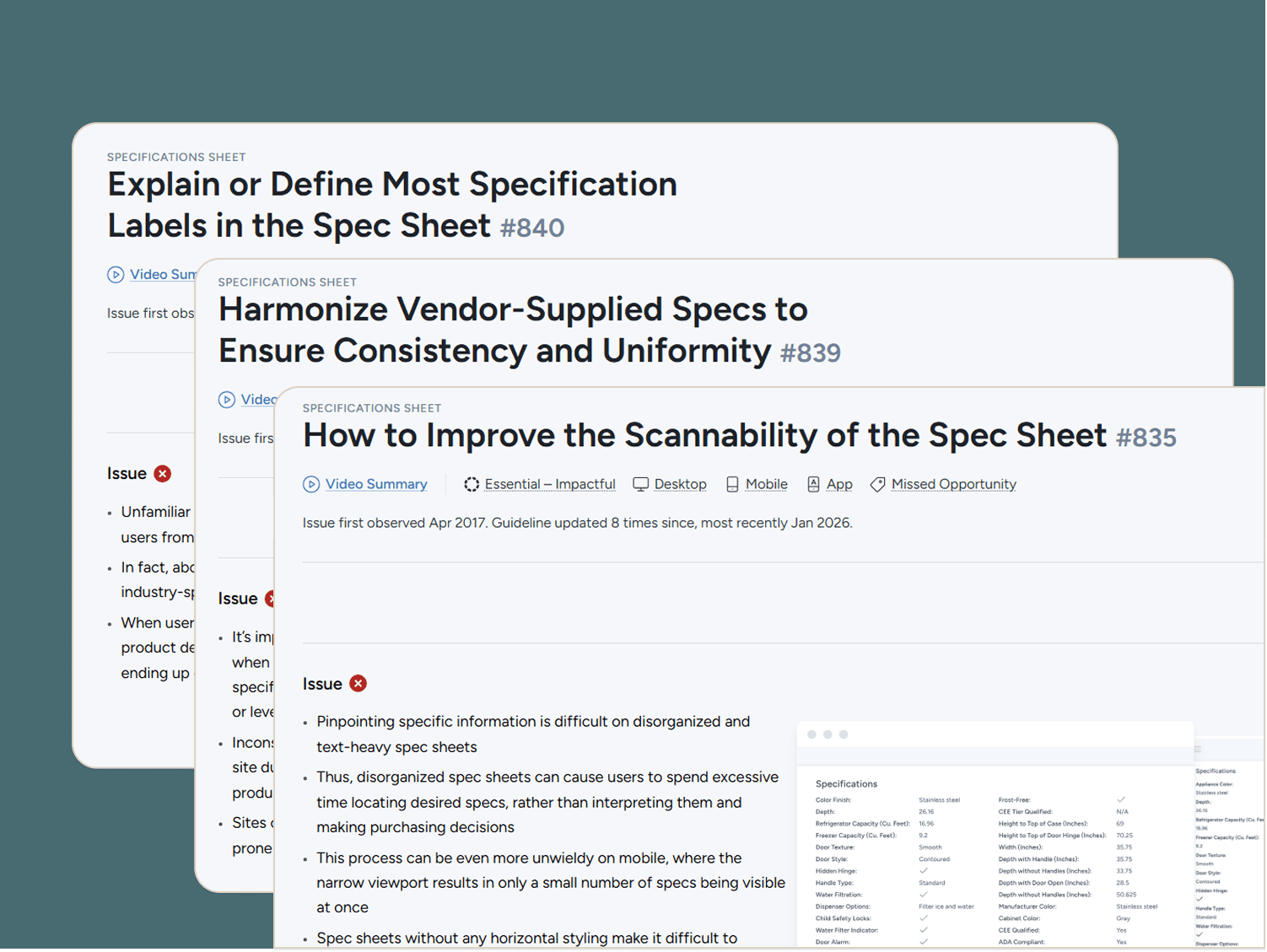
Industry research (Baymard) and competitor analysis reinforced that content clarity and scannable technical specifications are critical drivers of PDP engagement and conversion, validating our focus on information hierarchy and component placement.
WHAT I LEARNED FROM THE MARKET
Baymard Institute research recommends column layouts, clear grouping by category, and improved readability to reduce cognitive load.
Leading e-commerce platforms prioritize scannability and progressive disclosure for specs
Competitor analysis revealed clearer grouping of product attributes and comparison cues
HOW RESEARCH INFORMED DESIGN DECISIONS
Users scan specs, don’t read → Chunked & grouped specs
Too much info causes overload → Progressive disclosure
Comparison helps user makes decisions → Clear attribute grouping and comparison cues
Hypothesis
If we improve product clarity by restructuring technical specifications and optimizing the placement of key PDP components, users will better understand the product, feel more confident in their decision, and engage more deeply with the page.
Assumptions
Users are willing to buy but lack clarity
Content hierarchy impacts confidence
Small PDP changes can unlock growth
Evidence & Benchmarks
Industry research (Baymard) and competitor analysis reinforced that content clarity and scannable technical specifications are critical drivers of PDP engagement and conversion, validating our focus on information hierarchy and component placement.
WHAT I LEARNED FROM THE MARKET
Baymard Institute research recommends column layouts, clear grouping by category, and improved readability to reduce cognitive load.
Leading e-commerce platforms prioritize scannability and progressive disclosure for specs
Competitor analysis revealed clearer grouping of product attributes and comparison cues
HOW RESEARCH INFORMED DESIGN DECISIONS
Users scan specs, don’t read → Chunked & grouped specs
Too much info causes overload → Progressive disclosure
Comparison helps user makes decisions → Clear attribute grouping and comparison cues
Experiment: Improving Technical Specifications Layout
I conducted an A/B test in mobile and desktop comparing the original technical specifications layout with a structured, column-based version informed by industry research. The goal was to validate whether improved readability and grouping would reduce decision friction and increase engagement on PDPs.
What I tested
I ran an A/B test comparing the original technical specifications layout with a new structured version, featuring column-based organization, grouped attributes, and improved readability.
Why it mattered
Based on Baymard research and behavioral data, I hypothesized that clearer, scannable specs would reduce cognitive load and DSAT rates and support faster decision-making on PDPs.
How I measured success
Primary metrics included PDP engagement, interaction with specifications, and downstream conversion signals.

Tech Specs Enhancements
Before:
Content increased cognitive load
Increased page length
After:
Clear grouping by category
Improved product clarity and readability
Follows UX best practices
Shop Similar Products Placement
Before:
Placement too low in the page
Customer dropped off too soon
After:
Placement in the middle of the page (between Tech Specs and Feature information
Reduced bounce rate
Increased 8% engagement in Product Details pages

Evidence & Benchmarks
Industry research (Baymard) and competitor analysis reinforced that content clarity and scannable technical specifications are critical drivers of PDP engagement and conversion, validating our focus on information hierarchy and component placement.
WHAT I LEARNED FROM THE MARKET
Baymard Institute research recommends column layouts, clear grouping by category, and improved readability to reduce cognitive load.
Leading e-commerce platforms prioritize scannability and progressive disclosure for specs
Competitor analysis revealed clearer grouping of product attributes and comparison cues
HOW RESEARCH INFORMED DESIGN DECISIONS
Users scan specs, don’t read → Chunked & grouped specs
Too much info causes overload → Progressive disclosure
Comparison helps user makes decisions → Clear attribute grouping and comparison cues
Hypothesis
If we improve product clarity by restructuring technical specifications and optimizing the placement of key PDP components, users will better understand the product, feel more confident in their decision, and engage more deeply with the page.
Assumptions
Users are willing to buy but lack clarity
Content hierarchy impacts confidence
Small PDP changes can unlock growth
Key Outcomes & Results
+8% PDP engagement
↑ Increased interaction with specifications
↓ Reduced content-related dissatisfaction
Where users got stuck
High-intent users reached PDPs but lacked the clarity needed to confidently purchase, resulting in drop-offs, low conversion, high dissatisfaction rates and revenue impact.
Tech Specs Enhancements
Before:
Content increased cognitive load
Increased page length
After:
Clear grouping by category
Improved product clarity and readability
Follows UX best practices
Shop Similar Products Placement
Before:
Placement too low in the page
Customer dropped off too soon
After:
Placement in the middle of the page (between Tech Specs and Feature information
Reduced bounce rate
Increased 8% engagement in Product Details pages
Tech Specs Enhancements
Before:
Content increased cognitive load
Increased page length
After:
Clear grouping by category
Improved product clarity and readability
Follows UX best practices
Shop Similar Products Placement
Before:
Placement too low in the page
Customer dropped off too soon
After:
Placement in the middle of the page (between Tech Specs and Feature information
Reduced bounce rate
Increased 8% engagement in Product Details pages
Hypothesis
If we improve product clarity by restructuring technical specifications and optimizing the placement of key PDP components, users will better understand the product, feel more confident in their decision, and engage more deeply with the page.
Assumptions
Users are willing to buy but lack clarity
Content hierarchy impacts confidence
Small PDP changes can unlock growth
Key Learnings
Research and benchmarks are most valuable when used to inform concrete design decisions, not just document insights.
A/B testing is essential to validate hypotheses and prioritize changes that directly impact engagement and conversion.
Improving clarity at the decision point is a powerful growth lever in e-commerce.
Next Steps to Drive Further Growth
Deepen experimentation on PDP content and layout
Personalize technical specifications by user intent
Connect PDP learnings across the funnel
Key Outcomes & Results
+8% PDP engagement
↑ Increased interaction with specifications
↓ Reduced content-related dissatisfaction
Key Outcomes & Results
+8% PDP engagement
↑ Increased interaction with specifications
↓ Reduced content-related dissatisfaction
Key Learnings
Research and benchmarks are most valuable when used to inform concrete design decisions, not just document insights.
A/B testing is essential to validate hypotheses and prioritize changes that directly impact engagement and conversion.
Improving clarity at the decision point is a powerful growth lever in e-commerce.
Next Steps to Drive Further Growth
Deepen experimentation on PDP content and layout
Personalize technical specifications by user intent
Connect PDP learnings across the funnel
Key Learnings
Research and benchmarks are most valuable when used to inform concrete design decisions, not just document insights.
A/B testing is essential to validate hypotheses and prioritize changes that directly impact engagement and conversion.
Improving clarity at the decision point is a powerful growth lever in e-commerce.
Next Steps to Drive Further Growth
Deepen experimentation on PDP content and layout
Personalize technical specifications by user intent
Connect PDP learnings across the funnel